

Abstract
Many important data classes arise from interactions among people, between people and technology (built environment), and between people and nature (more than humans). Holistically, these interactions constitute ‘place’: a shared identity that should be revered and nurtured as the loom on which community health and wealth are intimately woven. Expanding from the control of industrial products, Digital Twin technologies increasingly model virtual copies of place to imitate living systems such as cities and ecosystems. Coupled with AI, place-based Digital Twins could facilitate scenario-based planning to help society navigate its wickedest problems. For positive outcomes, however, the underpinning data and models must be curated in the interests of those who have often been excluded from a normative ‘public’, and at scales appropriate to the social-ecological processes involved. To serve the common good this requires attention to often hidden social and cultural governance infrastructures. Here we propose ‘Foresight Commons’: a decentralized network of place-based data institutions controlled by local communities worldwide to address issues of social and environmental justice. We draw on the Local Contexts initiative to show how integrating principles like FAIR and CARE can offer a working model for the Foresight Commons, leveraging the frameworks of Indigenous data governance for the benefit of people and the intricate connections to place.
Keywords
Sustainability; traditional knowledge; open science; sustainable development goals; digital twins; environmental justice; collective intelligence; deliberative democracy; spatial web
Introduction
The UN Biodiversity Conference’s Kunming Declaration (CBD, 2021) calls for “Building a Shared Future for All Life on Earth.” But how might this be achieved when so many people have little power, while nature is often ignored by decision makers and exploited as raw resources? Indigenous knowledges, scientific understanding, and the digital revolution – as combined strengths – could provide key ingredients, helping humanity reach what the Declaration calls an “ecological civilization.” Navigating the Anthropocene/Capitalocene/Chthulucene, however, will require a radical upgrade in how local and Indigenous knowledges are recognized, valued, and protected; in how our data institutions are structured; and in what we accept as democracy (Crutzen, 2006; Haraway, 2015, Yusoff 2018). Indigenous Peoples continue to maintain unique forms of governance and decision-making in a colonized and global world. In Indigenous contexts, there is heightened awareness of how data impact social identity, economic equity, and environmental justice (Taylor & Kukutai, 2016; Tsosie, 2019; Walter et al., 2021). Cosmopolitan urbanites in ‘smart’ cities face related issues - for example, confronting what some see as an increasingly dystopian “surveillance economy” (Zuboff, 2019). How can people everywhere harness digital technologies without sacrificing identity, liberty, sovereignty, or even their humanity? A quintessentially 21st century problem, the most promising solutions tap into venerable practices almost lost to the grist of market-state ownership. These practices are notably making and remaking the ‘commons’, an ancient formula for the cooperative stewardship of shared resources that is infused with a complex interplay of governance in what is open and what is not (Ostrom, 2009).
While the industrial era privileged and fetishized private property (Piketty, 2020, Bhandar, 2018), the growing importance of digital assets has stimulated new economic thinking. In digitalized economies, many goods (e.g., information and ideas) are intangible, non-rivalrous, and context-specific (Haskel & Westlake, 2018). Might such conditions encourage greater collaboration over competition (Piketty, 2020) and favor commons-based approaches? Perhaps. But ever inventive, market capitalism is enclosing digital abundance and maintaining competitive mindsets through the creation of virtual scarcity. Intellectual property rights extend markets deep into the cyber realm (Determann, 2018) even as sensing and communication technologies generate data shareable at near-zero marginal cost opening possibilities for exponential innovation and abundance (Diamandis & Kotler, 2014). In what might be seen as a counter-movement to digital enclosure, states have pushed to make outputs of publicly-funded research open, sometimes with almost no conditions or restrictions to reuse. This approach forgets the uneven conditions in how data themselves are generated and from whom (Leonelli 2016; Leonelli, S., & N. Tempini, 2020). Generating quality data and building scientific models often requires significant investment beyond public funding, and rendering data “open access” can reduce incentives. Moreover, it is not always fair nor in the public interest – indeed, it can sometimes put people or biodiversity at risk, and/or disproportionately benefit rich countries and large corporations, perpetuating colonial extractive logics and consequent injustices.
A commons-based approach recognizes these challenges and seeks to navigate the middle ground - what the Open Data Institute calls the data sharing space. So-called “Web3” technologies, including distributed cyberinfrastructure such as the spatial web (René & Mapes, 2019) and blockchain-based innovations, from bitcoin to NFTs, could help here. These technologies make it possible to irrefutably own and track digital assets, trading them globally without centralized authority. Data might “want to be free” but Web3 introduces useful friction. While recognizing that Web3 technologies provide pathways for control through a familiar colonial property model base, there are other ways it could be imagined. If harnessed appropriately, Web3 could facilitate fair attribution and other rewards for contributing to digital commons, thus incentivizing prosocial behavior. Getting the balance right is particularly important for the digital predictions that increasingly underpin public policy, such as climate and disease modeling. Recognizing that collective intelligence is unlikely to emerge unless we consciously design for it (Mulgan, 2018), we argue for a global system of place-based data institutions, such as data trusts (Delacroix & Lawrence, 2019), to curate digital prediction assets that are built from local decision-making and governance .
Foresight Commons – an intelligent fabric for Island Earth
Smart governance is evidence-based, relying on good information to make good decisions. Within the context of rapid global change, better foresight is urgently needed to support effective policy (e.g., UN Scenario Planning for Human Mobility in the Context of Climate Change). Today, this foresight capacity is built on prediction assets composed of digital data and models, that is: (i) multiscale multimodal data from diverse remote and in situ observations, and (ii) computational models rooted in scientific understanding. As policymaking remains largely a territorial process, place-based data institutions are needed to curate these digital prediction assets in support of decisions across nested scales of governance. Provenance metadata - contextual information about where, when, who, how, and why digital assets were generated, processed, shared, and used - will be crucial. For example, knowing who contributed what enables attribution and distribution of fair rewards, incentivizing the creation of high-quality evidence. Provenance metadata is also essential for reliability and trust, helping to catch errors and screen out disinformation as nefarious actors seek to game decision-support systems. Interoperability and a sharing culture will be needed to enable learning among different places, motivating the development of standards and protocols for more effective actions at local, national, and regional scales. Networks of place-based data institutions will therefore require procedures for determining which digital predictions are ‘admissible’ locally to globally, invoking processes that are both political (within place) and diplomatic (between places). This digital prediction infrastructure is what we call the ‘Foresight Commons.’
Much groundwork has already been done to support the emergence of a Foresight Commons, notably the development of a global Open Science cyberinfrastructure (National Academies of Sciences, Engineering, and Medicine et al., 2018) and a proliferation of (meta)data standards, ranging from the Genomics Standards Consortium (Field et al., 2011) to the recent IEEE standard for the Provenance of Indigenous Peoples Data (Alliance, 2019; Carroll et al., 2020; Wilkinson et al., 2016) to cite just two examples. To encourage investment and to protect sensitive information, digital foresight assets require a nuanced form of stewardship rather than old colonial models of ownership. Traditional commons approaches can be well suited to the digital age where usage rights are highly dependent on governance from local contexts (Ostrom, 2009). Despite popular perceptions of the “tragedy of the commons,” properly constituted commons are not open access free-for-alls doomed to overexploitation by free riders. As a deliberate extra-legal strategy, breaking rules in the Foresight Commons might not lead to fines or jail time, but nor is it free of consequences; reputational damage, for example, can be a strong deterrent. We are not arguing against the need for legal protections in some circumstances, but for expanding society’s collective action toolbox; we need new extra-legal strategies that are not extensions of colonial infrastructure with dispossession built into them.
The curation of place-based foresight will require rules adapted to: (i) the fluid nature of digitalized economies, (ii) the inherent ambiguity of living systems, and (iii) the need to incentivize and protect citizens. What rules are appropriate, where and when, is dynamic and challenging; political and diplomatic. Successful governance, measured by how well it serves the common good, will likely embrace principles of subsidiarity (Blake & Gilman, 2026) and deliberative democracy (Landemore, 2020). Digital foresight draws on data from citizens, communities, governments, and businesses, as well as scientific observations and models, which are often publicly funded and globally accessible. It also relies on observing, computing, and simulation platforms that are currently controlled by a small number of powerful corporations and government agencies. Frameworks for negotiating terms of use, within and across actors and polities would benefit from more initiatives such as the Geneva Science & Diplomacy Anticipator (GESDA) and perhaps a permanent international body – a ‘World Foresight Organization’ – focused on equity, inclusion and deliberative decision-making.
As already noted, ‘commons’ is a widely experienced formula for the cooperative stewardship of shared resources. This formula has experienced extreme stress through colonial projects of extraction, to the extent that the very idea of a commons is not currently experienced evenly or as an inherent good. Our involvement in an initiative where scientific research overlaps with the management of Indigenous lands gives a specific illustration of the kind of advances needed to build the Foresight Commons as a public good lifted out of the colonial matrix of power that currently tends to define the contours of exclusion.
Case Study: Traditional Knowledge and Biocultural Labels
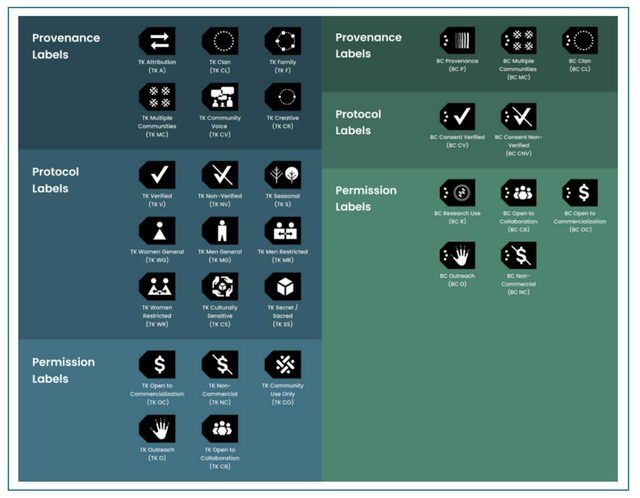
Recognizing the value of Indigenous and local knowledge and the need to appropriately organize its digital representation and provenance, the Traditional Knowledge (TK) and Biocultural (BC) Labels (Figure 1; www.localcontexts.org) were developed to refocus relationships between people, place, and data within archives, museums, libraries, and other institutional repositories (Local Contexts 2010, Anderson & Hudson, 2021). The Labels add context (social, cultural, ecological) that can enhance the scientific value of data and materials for reuse (e.g., in predictive modeling). Making Indigenous collections Findable, Accessible, Interoperable, and Reusable (the FAIR data principles, (Alliance, 2019; Carroll et al., 2020; Wilkinson et al., 2016), in the first instance, means understanding how they were created and the embedded structures of reuse. Historically, Indigenous collections were amassed (often by outsiders) without attention to the already existing and enduring Indigenous rules governing their circulation, and then stored with little knowledge about what they represent, or how they should be cared for. The Labels demarcate clear domains of Indigenous governance – responding to missing, incomplete, and impoverished information within Indigenous collection records, as well as the ongoing difficulties in finding Indigenous data within these contexts. Crucially, they reposition attention to ethics, responsibility and obligation, and center Indigenous epistemological understanding connecting pasts, presents and futures. For instance, the TK Seasonal Label links knowledge to place, providing clear rules for when certain knowledge should be used and when it shouldn’t. It makes visible contexts governed by seasonal (time of year) relationships between knowledge, ecosystems, organisms, and communities. This Label makes clear that there are existing governance conditions, for example, indicating when certain songs or stories should be told or certain biodiversity harvested, so the inherent teaching can properly unfold and have meaning.
Fig. 1: Schema of the Traditional Knowledge and Biocultural Labels (Anderson & Hudson, 2021)
Whereas FAIR data enables reuse mediated by machines, the Labels provide clear pathways for realizing the CARE Principles for Indigenous Data Governance affecting Collective benefit, Authority to control, Responsibility, and Ethics (Alliance, 2019). These human-centered principles engage ethical and social aspects; they respond to legal failure in addressing Indigenous needs to create parameters of protection for knowledge and data deriving from historical and contemporary contexts of research, collection, and preservation. Centering Indigenous relational capacities to maintain existing - and support emerging - data institutions, the Labels push (predatory) possessive law to the side, upending the tendency to rely on formal legislative (in)capacities to uphold informal relationships of care, responsibility, and obligation.
One of the key innovations of the Labels is that they intervene at the level of provenance metadata, ensuring relationships between Indigenous communities and data are appropriately represented within institutional repositories, and then also in the data journeys that ensue. They reposition Indigenous cultural authority and governance over data, artifacts, and material samples, adding critical information like community names and protocols for access, use, and circulation. Importantly the Consent Verified Label establishes visibility for consent to be part of how the data are known to have been generated. This is a significant practical step for elevating Free Prior and informed Consent (FPIC) in research to be seen not assumed, while also supporting Access and Benefit Sharing (ABS) provisions coming from the Nagoya Protocol and current debates around DSI in the Convention on Biological Diversity (Anderson et al., 2024). The durability of the Labels, and their contribution to the emerging Foresight Commons as culturally contextual metadata, is also in establishing norms that are maintained as material samples are digitized and travel across platforms nationally and internationally (Liggins et al., 2021). Richer metadata about how and where Indigenous collections derive makes Indigenous interests and relationships visible, present and clear for other participants to better engage with those communities. They help researchers and communities make more informed decisions about entering partnerships, and about the future use of materials, information, and knowledge. The Labels allow place-based data institutions (e.g., data trusts, or data commons), increasingly established by Indigenous communities themselves, to incorporate Indigenous protocols around appropriate access and use, and for these to be visible and machine actionable inside and outside the community. The new guidance for the Labels from the Biodiversity Data Standards organization TDWG (darwin core fields) and from the Creative Commons contribute to interoperability across data institutions. They empower a key constituency in the emerging Foresight Commons, providing a direct means for Indigenous authority to be acknowledged and integrated at a digital and people level (Hudson et al., 2021; Anderson et, al 2026). As noted earlier, Indigenous communities are in many ways ahead of other local communities in their awareness of the need for data sovereignty, but much of what we describe in this case study applies more generally, even in the most urbanized settings.
From Self-Driving Cars to Self-Stewarding Places?
If the evidence supporting place-based decisions is fairly curated in a Foresight Commons, might advances in Machine Learning and Artificial Intelligence (AI) facilitate the decision-making process itself? With greater capacity to shape our environment, society has more complex high-dimensional decisions to make. Indeed, with so many options, the choice is increasingly overwhelming even for well-paid, dedicated professionals let alone ordinary citizens. Computational platforms known as Digital Twins could be part of the solution. Simply put, a Digital Twin is “a model of a system that evolves together with the system over time” (Wright & Davidson, 2020). To illustrate the concept, which came from industry, consider how coupling ubiquitous sensors with powerful processors makes dumb products smart: fridges, cars, and buildings now adapt to changing conditions, sometimes in real-time. Digital Twins monitor networked products using Internet of Things technology, develop computational copies (hence the term “twin”), model these copies under different conditions (scenarios), and send algorithmically generated (automated) instructions back to the product in response to sensed data. Observation of outcomes either validates the models or provides data for improving them. Continuous operation allows an evolutionary process of iterative learning cycles (adaptation). Furthermore, the predictive models at the core of a Digital Twin can be shared across products operating in different settings so that each can benefit from the diverse experiences of the collective. Harnessing this diversity accelerates adaptation to a broader range of contexts – a form of collective machine learning with parallels to the role of human cognitive diversity in “democratic reasoning” (Landemore, 2017).
Digital Twins promise to improve real-world performance and resilience to shocks. The trend is most advanced for the built environment – in factories, homes, and smart cities – where industrial products are becoming aware of each other (machine ecology). With new ways to ‘listen’ to nature (e.g., computer vision, bioacoustic sensing, genomic sequencing) and powerful tools for intervening in natural processes (e.g., robotics, gene editing), it is not surprising that Digital Twin technology is beginning to be applied to organisms and ecosystems. Indeed to the whole planet: the European Commission recently launched the Destination Earth (DestinE) flagship project (Figure 2), which aims to “develop a highly-accurate digital model of the Earth (a digital twin of the Earth) to model, monitor and simulate natural phenomena, hazards and the related human activities. These groundbreaking features assist users in designing accurate and actionable adaptation strategies and mitigation measures.”
If the original point of Digital Twins was to help industrial products make better decisions for themselves, if the ‘product’ is a city, a forest, a sea, or our planet, might we begin to automate the stewardship of place? Now intelligent machines are capable of driving cars and supervising traffic, might society be tempted to delegate control of entire social-ecological systems to them too? Place-based Digital Twins might automatically redraw the boundaries of a marine protected area based on real-time fishing data, or change phytosanitary controls based on updated invasive species risk models, or issue new public health advisories based on environmental DNA sequences from a city’s sewage system. Even without going as far as automation, Digital Twins could have a role as sustainability simulators: models of place that improve as the outcomes of stewardship decisions feed into scientific understanding. Yet, as powerful as our technology and science is becoming, life is not a human product; we did not build organisms or ecosystems and we do not fully understand them. We never will. When it comes to living entities, Digital Twins will remain imperfect copies; they are hypotheses not clones. For this reason, “digital avatars” might be a less misleading, more humble term than “twin” for living systems (Davies et al., 2016). Digital ecosystem avatars are scientifically fallible, and as social constructs, they acknowledge human biases. If the avatars are coupled to data trusts under community control with democratic processes that filter admissible evidence, as envisaged here in a Foresight Commons, they might help mitigate disinformation and the misuse of AI.
Beyond security concerns around automated use of digital twins or avatars, even deeper issues must be addressed. These relate to the way we make collective decisions, not just how those decisions are informed. There is already a vast literature addressing the “ethics of AI” (Bostrom and Yudkowsky, 2014; Hagendorff, 2020; Siau and Wang, 2020; Crawford 2024 and Hao 2025) and a plethora of new institutes. Whether humans delegate the stewardship of a place to machines or to other humans (e.g., politicians), the fundamental challenge remains how to ensure decisions are made in the common good (an ‘alignment’ problem). Society has evolved mechanisms (albeit less than perfect ones) to constrain its (human) leaders and hold them to account. As humans delegate more decisions to machines, these mechanisms might become less appropriate and could completely break down. It is therefore prudent to develop social technology (institutions) that constrain digitally empowered decisions, whether they are taken by humans or directly made by machines. The application of AI and digital twins to social-ecological systems, whether opportunity and/or threat, should encourage us to rethink, even reinvent, our democracy. In society’s enthusiasm for the marvels of machine learning, we risk forgetting the value of democratic deliberation among humans when it comes to identifying the common good (Landemore, 2017), for humans and for more than human life (MOTH). Tactical decisions might be automated (e.g., self-driving cars), but strategic decisions (e.g., writing the highway code) should not be. Ultimately, humans must retain agency over the fundamental aspects of life (e.g., where do we want to drive to?) while machines help us get to the destination safely, achieving our common goals. Whatever scientific and technological systems develop, the design of societal cyberinfrastructure should be informed by the humanities and inspired by democratic ideals (Landemore, 2020).
Conclusions
We have argued that significant opportunities are emerging for data, models, and simulations to improve the predictive capacity underpinning community decision-support systems. Collective action requires a body of evidence to inform public policy and institutional practices to determine what evidence is admissible. Leveraging principles of Indigenous data sovereignty and the global social-technological infrastructure of Open Science, we propose curating digital predictions locally in democratic, values-based data institutions controlled by communities. Incorporating ethical, legal, and social issues, and including non-scientific sources of knowledge and data, this intelligent fabric would combine scientific understanding and traditional holistic values with deliberative democracy. Establishing networked place-based data institutions, like the Foresight Commons, is one way to build an AI-ready / AI-resilient society, accelerating the just transition to environmental sustainability, and perhaps even an “ecocivilization” (CBD, 2021).
Acknowledgements
The authors are grateful for discussions with colleagues including but not limited to Merc Fox, Alexander Mawyer, Tamatoa Bambridge, Maui Hudson, Libby Liggins, John Deck, Erin Robinson, Stephanie Carroll, Keolu Fox, Riley Taitingfong and Lydia Jennings as well as participants in the Geneva Science and Diplomacy Anticipator (GESDA) Task Force on Digital Empowerment. This essay reflects the perspectives of the authors and not necessarily those of their collaborators or affiliated institutions. We are also grateful to Cassidy Schoenfelder who helped with editing and layout.
Funding Information
The creation of this essay was supported by the U.S. National Science Foundation (NSF) award: “RCN: Sampling Nature: A Network to Enhance the Natural History Value Chain for Sustainability Science” (NSF 2129268) and drew on work carried out under “EAGER: The FAIR Island Project for Place-based Open Science” (NSF 2132549). The TK and BC Labels are currently funded by the Mellon Foundation. Both authors are currently funded by the Gordan and Betty Moore Foundation for the 'Science and Cultural Collaboration: Te Ora Fenua (Island Life)' (GBMF13115).Jane Anderson also has funding from the US National Science Foundation (NSF) award “STC - Center for Braiding Indigenous Knowledge in Science” (NSF 2243258). Any opinions, findings, and conclusions or recommendations expressed in this material are those of the authors and do not necessarily reflect the views of the National Science Foundation.
Competing Interests
The authors have no competing interests.
Author Contributions
The authors co-designed, drafted, and submitted the original version of the manuscript, based on the initial discussion held during a session at the “Extraction: Tracing the Veins” conference (2020) organized by Merc Fox.
Author Information
Dr Neil Davies is Director of the University of California’s Gump South Pacific Research Station on Moorea (French Polynesia) and Research Affiliate at the Berkeley Institute for Data Science. He is a founding director of Tetiaroa Society and serves on the board of the Genomic Standards Consortium. ORCID 0000-0001-8085-5014
Detailed Affiliations for Neil Davies 1,2
1 Gump South Pacific Research Station, University of California, Moorea, French Polynesia
2 Berkeley Institute for Data Science, University of California, Berkeley, USA
Dr Jane Anderson is an Associate Professor at New York University in Lenapehoking (New York) and Global Fellow in the Engelberg Center for Innovation Law and Policy in the Law School at NYU. Jane is co-founder of Local Contexts, which delivers the Traditional Knowledge and Biocultural Labels and Notices. She is also Director of the Indigenous Data Law Lab at NYU. ORCID 0000-0002-3304-0477
Detailed Affiliations for Jane Anderson3,4,5,6
3 Program for Museum Studies and Anthropology, New York University, Lenapehoking (NYC), USA
4 Engelberg Center for Innovation Law and Policy, New York University, Lenapehoking (NYC), USA
5 Indigenous Data Law Lab, New York University, Lenapehoking (NYC), USA
6 NSF Center for Braiding Indigenous Knowledge and Science
References
Alliance, G. I. D. (2019). CARE principles for Indigenous data governance. GIDA https://Www. Gida-Global. Org/Care.
Anderson, J., M. Hudson, C. Roe, H. Hopkins & V. Smith (2026), Guidance for Indigenous Collections and Indigenous Data: Recommendations from Creative Commons and Local Contexts. https://zenodo.org/records/22237037
Anderson, J., M. Hudson, S. RunningHawk & K. Riddle. (2024). “Recognizing Indigenous Interests: Labelling DSI with Provenance Metadata - Policy Brief. https://zenodo.org/records/13363077
Anderson, J., & Hudson, M. (2021). STEM Inclusive Teaching Practices Webinar Series: The Biocultural Labels Initiative. https://qubeshub.org/publications/2326
Bhandar, B. (2018), Colonial Lives of Property: Law, Land and Racial Regimes of Ownership. Duke University Press.
Blake, J. S., & Gilman, N. (2026). Children of a modest star. Stanford University Press.
Bostrom, N., & Yudkowsky, E. (2014). The ethics of artificial intelligence. The Cambridge Handbook of Artificial Intelligence (pp. 316–334). Cambridge University Press. https://doi.org/10.1017/CBO9781139046855.020
Carroll, S. R., Garba, I., Figueroa-Rodríguez, O. L., Holbrook, J., Lovett, R., Materechera, S., Parsons, M., Raseroka, K., Rodriguez-Lonebear, D., Rowe, R., Sara, R., Walker, J. D., Anderson, J., & Hudson, M. (2020). The CARE principles for indigenous data governance. Data Science Journal, 19. https://doi.org/10.5334/dsj-2020-043
CBD. (2021). Kunming Declaration: "Ecological civilization: building a shared future for all life on Earth”. Conference to the Parties to the Convention on Biological Diversity. https://www.cbd.int/doc/c/c2db/972a/fb32e0a277bf1ccfff742be5/cop-15-05-add1-en.pdf
Crawford, K. (2021). Atlas of AI: Power, Politics and the Planetary Costs of Artificial Intelligence. Yale University Press.
Crutzen, P. J. (2006). The “anthropocene.” Earth system science in the anthropocene (pp. 13-18). Berlin, Heidelberg: Springer Berlin Heidelberg. https://doi.org/10.1007/3-540-26590-2_3
Davies, N., IDEA Consortium, Field, D., Gavaghan, D., Holbrook, S. J., Planes, S., Troyer, M., Bonsall, M., Claudet, J., Roderick, G., Schmitt, R. J., Zettler, L. A., Berteaux, V., Bossin, H. C., Cabasse, C., Collin, A., Deck, J., Dell, T., Dunne, J., … Wood, S. (2016). Simulating social-ecological systems: the Island Digital Ecosystem Avatars (IDEA) consortium. In GigaScience (Vol. 5, Issue 1). https://doi.org/10.1186/s13742-016-0118-5
Delacroix, & Lawrence. (2019). Bottom-up data Trusts: disturbing the ’one size fits all’approach to data governance. International Data Privacy Law. https://doi.org/10.1093/idpl/ipz014
Determann, L. (2018). No One Owns Data. https://doi.org/10.2139/ssrn.3123957
Diamandis, P. H., & Kotler, S. (2014). Abundance. Free Press.
Field, D., Amaral-Zettler, L., Cochrane, G., Cole, J. R., Dawyndt, P., Garrity, G. M., Gilbert, J., Glöckner, F. O., Hirschman, L., Karsch-Mizrachi, I., Klenk, H.-P., Knight, R., Kottmann, R., Kyrpides, N., Meyer, F., San Gil, I., Sansone, S.-A., Schriml, L. M., Sterk, P., … Wooley, J. (2011). The Genomic Standards Consortium. PLoS Biology, 9(6), e1001088.
Hagendorff, T. “The Ethics of AI Ethics: An Evaluation of Guidelines.” Minds & Machines 30, 99–120 (2020). https://doi.org/10.1007/s11023-020-09517-8
Hao, K. (2025). Empire of AI: Dreams and Nightmares in Sam Altman’s Open AI. Penguin Press.
Haraway, D. (2015). Anthropocene, capitalocene, plantationocene, chthulucene: Making kin. Environmental humanities, 6(1), 159-165. https://doi.org/10.1215/22011919-3615934
Haskel, J., & Westlake, S. (2018). Capitalism without Capital: The Rise of the Intangible Economy. Princeton University Press.
Hudson, M., Anderson, J., & Sterling, R. (2021). Indigenous Data Sovereignty: From Intellectual Property to Traditional Knowledge Labels’. In K. Ruckstuhl & M. Kawhuru (Eds.), Innovation, Maori, Science and Technology. Bridget Williams Books, New Zealand. Bridget Williams Books.
Landemore, H. (2017). Democratic Reason: Politics, Collective Intelligence, and the Rule of the Many. Princeton University Press.
Landemore, H. (2020). Open Democracy: Reinventing Popular Rule for the Twenty-First Century. Princeton University Press.
Leonelli, S. (2016). Data-Centric Biology: A Philosophical Study. University of Chicago Press.
Leonelli, S., & N. Tempini, (2020). Data Journeys in the Sciences. Springer Press.
Liggins, L., Hudson, M., & Anderson, J. (2021). Creating space for Indigenous perspectives on access and benefit-sharing: Encouraging researcher use of the Local Contexts Notices. Molecular Ecology, 30(11), 2477–2482.
Mulgan, G. (2018). Big Mind: How Collective Intelligence Can Change Our World. Princeton University Press.
National Academies of Sciences, Engineering, and Medicine, Policy and Global Affairs, Board on Research Data and Information, & Committee on Toward an Open Science Enterprise. (2018). Open Science by Design: Realizing a Vision for 21st Century Research. National Academies Press.
Ostrom, E. (2009). A general framework for analyzing sustainability of social-ecological systems. Science, 325(5939), 419–422.
Piketty, T. (2020). Capital and Ideology. Harvard University Press.
René, G., & Mapes, D. (2019). The Spatial Web: How Web 3.0 Will Connect Humans, Machines and AI to Transform the World. Gabriel René and Dan Mapes.
Taylor, J., Kukutai, T., & Australian National University. (2016). Indigenous data sovereignty: toward an agenda (J. Taylor & T. Kukutai, Eds.). Centre for Aboriginal Economic Policy Research, issuing body. Australian National University Press. https://doi.org/10.22459/CAEPR38.11.2016
Tsosie, R. (2019). Tribal Data Governance and informational privacy: constructing “Indigenous data sovereignty.” Montana Law Review, 80(2). https://heinonline.org/hol-cgi-bin/get_pdf.cgi?handle=hein.journals/montlr80§ion=13
Walter, M., T. Kukutai, S. R. Carroll, & D. Rodriguez-Lonebear (Eds.). (2021). Indigenous Data Sovereignty and Policy (1st ed.). Routledge. https://doi.org/10.4324/9780429273957-14
Wilkinson, M. D., Dumontier, M., Aalbersberg, I. J. J., Appleton, G., Axton, M., Baak, A., Blomberg, N., Boiten, J.-W., da Silva Santos, L. B., Bourne, P. E., Bouwman, J., Brookes, A. J., Clark, T., Crosas, M., Dillo, I., Dumon, O., Edmunds, S., Evelo, C. T., Finkers, R., … Mons, B. (2016). The FAIR Guiding Principles for scientific data management and stewardship. Scientific Data, 3, 160018.
Wright, L., & Davidson, S. (2020). How to tell the difference between a model and a digital twin. Adv Model Simul Eng Sci 7: 1–13.
Yusoff, K. (2019), A Billion Black Anthropocene’s or None. University of Minnesota Press.
Zuboff, S. (2019). The Age of Surveillance Capitalism: The Fight for a Human Future at the New Frontier of Power. Profile Books.
Provenance history for this DOI, recorded by DataCite. Each entry is a registered metadata version.
Loading revision history…
Powered by MGC Re-Curation Watch and the DataCite API.
Works connected to this record, from its own metadata and from DataCite. Click a bubble to open it.
Loading connections…