
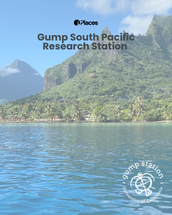
Gump South Pacific Research Station · iPlaces
Before 2025
Earlier works migrated into iPlaces from the prior platform.
Led by Tahiti’s biomedical research center, Institute Louis Malardé (ILM) and the UC Gump South Pacific Research Station on Moorea, the MOZEROA (mo-zie-roh-ah) project draws on successful trials on Tetiaroa atoll to target Huahine for the first island-wide mosquito elimination on a high island. MOZEROA 2030: Innovative Mosquito Control on Huahine Island (the Project) aims to suppress and eventually eliminate the risk of mosquito-borne diseases (“mosquito net zero”) from Huahine as proof of concept for treating entire islands in French Polynesia by 2030.
Biocode 2.0 Moorea Coral Reef Hologenome Sequencing project (the Project) will advance scientific understanding of the unseen biodiversity of reefs and how this diversity responds to and recovers from disturbances. The Project outcomes will help identify how human communities can alter reef health trajectories toward desirable outcomes in the face of global climate change. The Project will create new, diverse, and contextualized marine genomic resources for ecologically, culturally, and economically important organisms and their symbionts from the island of Moorea.
The Project will combine with a data trust model (iPlaces) to better operationalize the FAIR and CARE data principles, including ethical, legal and social issues. Additionally, the Ethnocode Framework will support educational programs through the Atitia Community Center, including “Island Sampling Days'' as nuclei for a range of outreach activities engaging local schools, institutions of higher education, and professional training.
Research frequently uses material samples as a basic element for reference, study, and experimentation in many scientific disciplines, especially in the natural and environmental sciences, material sciences, agriculture, physical anthropology, archaeology, and biomedicine. Observations made on samples collected in the field and in the laboratory constitute a critical data resource for research that addresses grand challenges of our planet's future sustainability, from environmental change; to food, energy, and water resources; to natural hazards and their mitigation; to public health. The large investments of public funds being made to curate huge volumes of samples acquired over decades or even centuries, and to collect and analyze new samples, demand that these samples be openly accessible, easily discoverable, and documented with sufficient information to make them reusable. The current ecosystem of sample and sample data management in the U.S. and globally is highly fragmented across stakeholders, including museums, federal agencies, academic institutions, and individual researchers, with a multitude of institutional and discipline-specific catalogs, practices for sample identification, and protocols for describing samples. The iSamples project is a multi-disciplinary collaboration that will develop a national digital infrastructure to provide services for globally unique, consistent, and convenient identification of material samples; metadata about them; and linking them to other samples, derived data, and research results published in the literature. iSamples builds on previous initiatives to achieve these goals by providing material samples with globally unique, persistent identifiers that reliably link to landing pages with metadata describing the sample and its provenance, and which allow unambiguously linking samples with data and publications. Leveraging significant national investments, iSamples provides the missing link among (i) physical collections (e.g., natural history museums, herbaria, biobanks), (ii) field stations, marine laboratories, long-term ecological research sites, and observatories, and (iii) data repositories and cyberinfrastructure. iSamples delivers enhanced infrastructure for STEM research and education, decision-makers, and the general public. iSamples benefits national security and resource management by offering a means to assure sample provenance, improving scientific reproducibility and demonstrating compliance with ethical standards, national regulations, and international treaties.
The Internet of Samples (iSamples) is a multi-disciplinary and multi-institutional project to design, develop, and promote service infrastructure to uniquely, consistently, and conveniently identify material samples, record metadata about them, and persistently link them to other samples and derived digital content, including images, data, and publications. The project will create a flexible and scalable architecture to ensure broad adoption and implementation by diverse stakeholders. iSamples will build upon existing identifier infrastructure such as IGSNs (Global Sample Number;) and ARKs (Archival Resource Keys), but is agnostic to identifier type. Likewise, iSamples will encourage a high-level metadata standard for natural history samples (across biosciences, geosciences, and archaeology), while supporting community-developed metadata standards in specialist domains. Through integration with established discipline-specific infrastructure at the System for Earth Sample Registration SESAR (geoscience), CyVerse (bioscience), and Open Context (archaeology), iSamples will extend existing capabilities, enhance consistency, and expand their reach to serve science and society much more broadly. The project includes three main objectives: 1) Design and develop iSamples infrastructure (iSamples in a Box and iSamples Central); 2) Build four initial implementations of iSamples for adoption and use case testing (Open Context, GEOME, SESAR, and Smithsonian Institution); and 3) Conduct outreach and community engagement to developers, individual researchers, and international organizations concerned with material samples. The project will follow an agile development process that includes community engagement as an important element of creating software requirements and an implementation timeline.
For all related works see the DataCite Commons Page:
The purpose of this project is to create the first DNA barcode-based 'All Taxa Biological Inventory' of a model ecosystem, specifically the island of Moorea. The work will accelerate ecological discovery and enable the development of more innovative and effective conservation strategies. The core goal of the Moorea Biocode Project (MBP) is to genetically barcode every non-microbial species on Moorea. We will thus create a professionally produced, verifiable (vouchered). All Taxa Biotic Inventory (ATBI) of Moorea (Output 1), together with the informatics services needed for ATBI and biocode-enabled research in Model Ecosystems (Outcome 2). We will also design a long-term plan (business model) to ensure the financial self-sustainability of biocode services, and carry out proof of concept studies to encourage broad-based support from funding agencies (Output 3).
The Moorea 2013 class is a University of California, Berkeley field course entitled Biology and Geomorphology of Tropical Islands. Based at the Richard B. Gump South Pacific Research Station on the island of Moorea in French Polynesia, the course involves students conducting independent research projects across a variety of marine and terrestrial habitats. Student research spans diverse subjects such as the effects of ocean acidification on marine shrimp and nudibranchs, the feeding preferences of stream invertebrates, honey bee visitation habits, and the antimicrobial properties of plants used in traditional Tahitian medicine. Additional projects investigate parasite-host relationships in geckos and fiddler crabs, ecological succession in epiphytic communities and burned forests, and the role of cryptic coloration in giant clams and skinks. Throughout the term, students are trained in experimental design, rigorous field data collection, and statistical analysis using R software. These research efforts are supported by a team of professors and graduate student instructors who mentor the students from initial fieldwork through the completion of their final scientific papers.
The Mo’orea field course, also known as ESPM 107 or IB 158LF, was a nine-week research expedition conducted in late 2012 at the University of California Gump South Pacific Research Station in Mo’orea, French Polynesia. The curriculum was taught by professors Brent Mishler, Jonathon Stillman, George Roderick, Vincent Resh, Stephanie Carlson, Tom Bruns, and Matteo Garbelotto, with support from graduate student instructors Rosemary Romero, Matthew Luskin, and Darcy Kato-Ernst. Students were tasked with conducting independent research projects on various aspects of tropical ecology, biology, and geomorphology, utilizing Mo’orea as a biological and ecological sandbox. These projects covered a wide array of topics, including the effects of climate change on marine development, symbiotic interactions between crabs and anemones, spider cannibalism, coral disease, and the distribution of zooplankton, fungi, and bryophytes. The course combined intensive field surveys and laboratory experiments with quantitative analysis using JMP software. In addition to academic rigor, the program emphasized cultural enrichment and collaboration among the student group.
The Fall 2011 UC Berkeley course, “The Biology and Geomorphology of Tropical Islands”, is a University of California Berkeley course held at the Richard B. Gump South Pacific Research Station in French Polynesia. Professors George Roderick, Vincent Resh, Jere Lipps, and Patrick Kirch guide students through the entire scientific process, from initial field observations to the publication of final research papers. The sources feature independent research on diverse ecological topics, including the social structures of Tahitian rays, anti-predator behaviors in sea urchins, and the visual cues used by angelfish to assess threat. Other student projects examine the impacts of invasive species like birds and ants, mutualistic relationships such as those between sea star shrimp and cushion stars, and the legacies of prehistoric Ma'ohi land use on modern forest composition. Additionally, students conduct studies on marine environmental health, including comparative assessments of coral disease and the distribution of suspension feeders
The 2010 Biology and Geomorphology of Tropical Islands is a field-based research class from the University of California, Berkeley, conducted on the island of Mo'orea, French Polynesia. The course provides students with the opportunity to design and execute original scientific studies across a wide range of tropical ecosystems, including coral reefs, mountain ridges, and freshwater streams. Instruction is provided by professors from departments such as Integrative Biology and Environmental Science, Policy, and Management, with additional support from graduate student instructors. Students utilize the facilities at the Richard B. Gump South Pacific Research Station and the Atitia Center to process samples and perform data analysis. Research topics typically address environmental issues like the impact of invasive species, human development, and biodiversity conservation. The culmination of the class involves producing formal research papers that contribute to the documented natural history and ecological understanding of the island
The Mo'orea Class of 2009 was an intensive field research course led by professors Brent Mishler, Pat Kirch, George Roderick, and Vince Resh. Based at the Richard B. Gump South Pacific Research Station in French Polynesia, the class involved students conducting independent studies across various scientific disciplines including integrative biology, anthropology, and geomorphology. Research projects explored diverse ecological themes such as the defensive roles of crustaceans in coral colonies, the impact of invasive trees like Falcataria moluccana, and the distribution patterns of marine and terrestrial gastropods. Students also examined human-driven environmental changes, ranging from the geomorphological effects of boating on reef islets to the historical impact of coral collection for ancient Polynesian marae construction. The curriculum emphasized rigorous data collection and statistical analysis using software like JMP to evaluate biological patterns such as zooplankton abundance cycles and jumping spider aggression. Throughout their projects, students worked closely with graduate student instructors David Hembry, Maya deVries, and Stephanie Bush, while also collaborating with local Tahitian experts and the Moorea Biocode Project.
The UC Berkeley class ESPM 107/IB 158, also known as Biology and Geomorphology of Tropical Islands, was conducted in Moorea, French Polynesia, in late 2008. Students in the class performed field-based investigations across a wide range of ecological and biological topics, including marine community metabolism, the impact of invasive species on native flora, and the behavior of island fauna like hermit crabs and spiders. Research also addressed human-driven environmental changes, such as the effects of agricultural runoff on planktonic shrimp and the influence of ecotourism on pink whipray populations. The academic structure of the class involved students developing hypotheses, gathering data through transects, quadrats, or lab experiments, and conducting statistical analyses to test their findings. These projects were supported by UC Berkeley faculty and staff at the Richard B. Gump South Pacific Research Station.
The sources consist of final research papers from the 2007 University of California, Berkeley course titled Biology and Geomorphology of Tropical Islands. The class took place on the island of Moorea, French Polynesia, with students based at the Richard B. Gump South Pacific Research Station. Throughout the course, participants engaged in original scientific inquiry by designing and executing independent research projects across marine, freshwater, and terrestrial environments. These studies addressed a wide array of topics, including the behavior of marine mollusks and hermit crabs, the distribution of invasive plant species like falcata trees and Lantana, the thermoregulatory needs of local lizards, and the ecological succession of invertebrates in decomposing Tahitian chestnut fruit. Methodologically, students utilized field surveys involving transects and quadrats, laboratory manipulations, and technical tools such as geographic information systems (GIS) and statistical analysis software to evaluate their data. The class served as a platform for students to explore complex biological interactions and environmental issues, such as the impact of agricultural runoff on stream diatoms and the role of various organisms in the tropical carbon cycle
The Biology and Geomorphology of Tropical Islands class, also known as ESPM 107 and IB 158, is a semester-long field science course for undergraduates at the University of California, Berkeley. In the fall of 2006, 22 students spent nine weeks on the island of Moorea in French Polynesia conducting original research at the Richard B. Gump South Pacific Research Station. The curriculum focuses on moving students from the lecture hall into the world of professional science through the creation, design, and completion of unique research projects covering biology, geology, oceanography, and anthropology. Students explore diverse environments including reefs, highlands, and mangrove swamps to find specific research interests. The course structure includes three weeks of preparation in Berkeley, nine weeks of field research in Moorea, and two final weeks back in Berkeley for final analysis and the publication of their results in a research volume.
The 2005 Moorea Class, officially titled Biology and Geomorphology of Tropical Islands, is a semester-long undergraduate course offered by the University of California, Berkeley. The program begins with three weeks of intensive study and preparation on the Berkeley campus before students travel to the island of Moorea in French Polynesia. Based at the Richard B. Gump South Pacific Research Station, students transition from lecture halls to professional scientific investigation by designing and executing original research projects in diverse habitats such as coral reefs and tropical forests. During the final weeks of the semester, students return to Berkeley to finalize their work, deliver presentations at a public research symposium, and publish their findings in a series of research books.
The Moorea Class of 2004 was a semester-long undergraduate course from the University of California, Berkeley, officially known as Biology and Geomorphology of Tropical Islands. The class consisted of twenty students who traveled to the island of Moorea in French Polynesia to conduct original research projects. Based at the Richard B. Gump South Pacific Biological Research Station, the students spent nine weeks in the field after three weeks of preparation in Berkeley. Research topics were diverse, encompassing terrestrial and marine biology, botany, and geomorphology. The program was designed as a research expedition, involving planning, field reconnaissance, and the design and implementation of individual scientific studies. Upon returning to Berkeley, the students presented their results at a public research symposium and produced written papers. These papers were compiled and published in Volume 13 of the Moorea Student Papers series. The course was led by a team of faculty members and Graduate Student Instructors with expertise in various scientific disciplines.
Biology and Geomorphology of Tropical Islands is a semester-long University of California, Berkeley course officially known as Integrative Biology 158 and Environmental Science, Policy, and Management 107. The class includes a nine-week field research expedition to Moorea, French Polynesia, where students live and work at the Richard B. Gump South Pacific Biological Research Station. The core purpose of the course is to move undergraduates from the lecture hall into professional field science by requiring them to design and implement their own original research projects. Students spend three weeks at Berkeley preparing for the trip, nine weeks on the island for reconnaissance and research, and two weeks back on campus for final presentations. The curriculum is interdisciplinary, covering topics such as marine and terrestrial biology, geology, botany, oceanography, and anthropology. Since the course began in 1991, hundreds of students have completed original research that is presented at an annual symposium and published in a distributed series of research books.
The 2002 Biology and Geomorphology of Tropical Islands is a University of California, Berkeley course offered as Integrative Biology 158 and Environmental Science, Policy, and Management 107. The program aims to transform undergraduate students into professional scientists through the design and implementation of original research projects conducted on the island of Moorea in French Polynesia. The curriculum begins with three and a half weeks of preparatory study in Berkeley focused on science background and logistical planning. This is followed by a nine-week stay at the Richard B. Gump South Pacific Biological Research Station, where students spend an initial week exploring diverse habitats like reefs, streams, and mountains before conducting eight weeks of independent research. The course concludes with students giving oral presentations at an annual symposium and producing written scientific papers for publication in a distributed volume. Since its inception in 1991, the program has been highly successful, with many student projects eventually being published in standard scientific journals. Participants often describe the experience as life-changing because it covers a complete research cycle from planning to reporting results.
The Fall 2001 UC Berkeley course, "Biology and Geomorphology of Tropica Islands" (Integrative Biology 158 / Environmental Science, Policy and Management 107), was a collaborative program run by the Departments of Integrative Biology and Environmental Science, Policy and Management. Science, Policy, and Management. Led by lead instructor Brent D. Mishler and field faculty members Tom Carlson, Rosie Gillespie, Carole Hickman, and George Roderick, the class focused on an all-inclusive research experience and full immersion in the life of science. The core of the course was an immersive nine-week field research component on the island of Moorea in French Polynesia, based at the Richard B. Gump South Pacific Biology. Research Station. During their time on the island, 21 undergraduate students conceived and conducted independent research projects with the close mentorship of UC faculty and graduate student instructors Elin Claridge, Anya Hinkle, and Crissy Huffard. The class culminated in a professional-style symposium and a comprehensive course report compiling 21 individual scientific papers detailing their findings across Moorea's marine and terrestrial environments.
"The Biology and Geomorphology of Tropical Islands" (ESPM 107 / IB 158) is an intensive undergraduate course offered by the University of California, Berkeley, designed to transform students into professional natural scientists through the design and implementation of original research projects. Based at the Richard B. Gump South Pacific Biological Research Station on the island of Moorea, French Polynesia, the class begins with three and a half weeks of preparatory scientific and logistical training in Berkeley followed by a nine-week field research portion in the South Pacific. Under the guidance of a teaching team from the departments of Integrative Biology and Environmental Science, Policy and Management, students conduct eight weeks of independent field research on diverse topics ranging from marine reef biota to high-elevation terrestrial flora. The course, which has been highly successful since its inception in 1991, culminates in a formal symposium presentation and the production of scientific papers, many of which are eventually published in professional journals.
The student research papers from the 1999 Moorea course provide a broad scientific examination of the island's marine and terrestrial environments. Marine research focused on how physical wave forces influence reef morphology and how coral branch spacing affects the colonization of damselfish. Invertebrate studies documented the high sediment turnover rate of Black Sea Cucumbers and the symbiotic color-matching abilities of commensal shrimp on sea stars. Behavioral experiments explored the photosensitivity of upside-down jellyfish and the escape responses of jumping clams. Other marine studies investigated the diurnal distribution of reef fish and the use of chemical cues in nudibranch aggregation. Terrestrial research included a systematic survey of morning glory species and an investigation into the asexual reproduction of forest lianas through runners. Studies on fire scars revealed that fire significantly reduces plant species richness for years, often leading to the dominance of a single native fern species. Research into the native Metrosideros collina tree suggested its low recruitment results from seedling shade-intolerance rather than pollinator loss. Animal behavior studies identified territorial aggression and peak feeding times in geckos and found higher bird species richness in structurally complex habitats. Experiments with pygmy octopuses assessed their learning capabilities, while research on freshwater shrimp showed they prefer microbes over leaf material and adapt well to flash floods. Conservation-focused surveys tracked micro-gastropod populations following the extinction of Moorea's endemic tree snails. Finally, papers on human impact compared species richness between natural and resort beaches and assessed the agronomic damage caused by banana weevils on local farms.
This collection of documents details a 1998 field research program conducted by the University of California, Berkeley, at the Gump South Pacific Biological Research Station in Moorea, French Polynesia. The materials include a course overview, a list of student projects, and a specific scientific paper focused on stomatopod crustaceans living in coral rubble. These student-led investigations cover a wide range of topics, including marine biology, ecology, and geomorphology, often utilizing the local landscape of Cook’s Bay as a primary study site. The documentation emphasizes a hands-on apprenticeship model, where undergraduates transition into professional scientists by executing original research in a tropical island environment. Key themes include the relationship between organism distribution and habitat characteristics, as well as the historical context of early Pacific exploration by figures like James Cook. Overall, the sources celebrate the academic success and scientific contributions of the students who participated in this immersive educational experience.
The Fall 1997 course "Biology and Geomorphology of Tropical Islands" was an intensive, 15-week interdisciplinary field research program offered by the University of California, Berkeley, which provided sixteen selected undergraduates the unique opportunity to "learn science by doing science" in the extraordinary setting of Moorea, French Polynesia. Based at the Richard B. Gump South Pacific Biological Research Station, the curriculum spanned diverse disciplines including zoology, botany, ecology, geology, geography, and conservation biology. The course was structured into three distinct phases: an initial month of preparatory lectures and workshops in Berkeley, followed by an eleven-week field residency—consisting of two weeks of intensive introduction to the island's natural history and nine weeks of independent project execution—and concluding with two weeks of data analysis and formal symposium presentations back on campus. Under the guidance of faculty led by Professor Carole S. Hickman, students conducted original research on a wide array of topics, such as the behavior of freshwater eels, the spread of the invasive tree Miconia calvescens, the impact of pineapple cultivation on tropical soils, and the complex ecology of the island's fringing reefs and intertidal gastropod communities.
This is a rare course in the modem age of college education, an interdisciplinary course open only by application and interview, that occupies one whole semester (13 units), with a student : teacher ratio of about 2:1, featuring all-inclusive research experience and full immersion in the life of science and a foreign culture. The 15 students spend a month in Berkeley for lectures and labs five days a week, then go to the Richard B. Gump South Pacific Biological Research Station on Moorea in French Polynesia for two months to carry out an intensive research project as well as some general educational field trips and group projects, finally returning to Berkeley for two weeks of non-stop data analysis, library research, and writing. Following a round of peer reviews, the students prepare camera-ready copies for their papers and give an oral presentation in a professional-style symposium. The 1996 class, whose papers follow in this book, set new standards of achievement and formed bonds with each other and the teaching staff that will last a long time. The professors (who spent 1-3 week periods each on Moorea) and the Graduate Student Instructors (who spent the whole two months on Moorea) had a unique opportunity to help each student design their project, go with them in the field, observe their data-gathering and work habits, and assist them in the analysis and write-up phase. This close living and working situation allows the transfer of fundamental methods, theories, and even attitudes about science, in addition to the expected transfer of basic information about islands and their biology.
The 1995 Moorea Class, officially titled The Biology and Geomorphology of Tropical Islands, was an undergraduate course through the University of California, Berkeley. The academic program started with four weeks of preparation and lectures at Berkeley and the Bodega Marine Laboratory before the participants moved to Moorea in French Polynesia. The group consisted of fifteen undergraduates, faculty members, and two graduate student instructors. During their nine-week stay at the Gump Biological Research Station, students participated in field trips and focused on original research projects. The course concluded with a December symposium at Berkeley where students presented their findings on topics like coral reef ecology, plant studies, and geomorphology
The Biology and Geomorphology of Tropical Islands is an undergraduate course from the University of California, Berkeley, that has been taught each fall since 1991. For the 1994 session, seventeen upper division students were selected through an application process to participate in the program. The academic term began with four weeks of lectures and research planning at the Berkeley campus before students traveled to the Richard P. Gump Biological Station on the island of Moorea, French Polynesia. During their seven-week stay on the island, students engaged in total immersion that included field trips to various islands, cultural interactions, and the execution of original research projects. The instructional staff consisted of faculty experts and three graduate student instructors who provided guidance in the field. Upon returning to Berkeley, students presented their research results at a symposium and compiled their final reports into a published volume.
The Biology and Geomorphology of Tropical Islands was a Fall 1993 undergraduate course at the University of California Berkeley. Led by principal instructor Dr Mary Power and teaching assistants Fred Booker and Tim Krantz, the class focused on the ecology and geomorphology of terrestrial and marine environments on tropical islands. The fifteen enrolled students spent the first seven weeks on the Berkeley campus attending lectures given by leading scholars from various departments. Following this campus component, the class traveled to the Gump Marine Biological Field Station on the island of Moorea in French Polynesia for seven weeks of field work. During this time, the students focused primarily on conducting independent research projects covering diverse topics such as coral reef ecosystems, agriculture, invasive plant species, and human environmental impacts. Upon returning to Berkeley, the students presented their research at an oral symposium and compiled their findings into a final volume of research papers.
The Fall 1992 UC Berkeley course, "The Ecology and Geomorphology of Tropical Islands" (Interdepartmental Studies 158), was a collaborative program run by the Departments of Integrative Biology and Geography. Led by faculty members Carla D'Antonio and David R. Stoddart, the class focused on the study of terrestrial and marine environments on tropical islands. The core of the course was an immersive seven-week field research component on the island of Moorea in French Polynesia, based at the UC Richard C. Gump South Pacific Biological Field Station. During their time on the island, 15 undergraduate students conceived and conducted independent research projects with the guidance of UC faculty and graduate students. The class culminated in a comprehensive course report compiling 11 individual and two joint scientific papers detailing their findings.